01
Executive Summary
Internet participation is mediated through identities and controls created by service providers, employers, governments, device vendors, applications, and network operators. Each relationship may be legitimate, but the individual is repeatedly represented as an account inside someone else’s system.
Existing technologies solve important parts of this environment. VPNs protect traffic. Mesh systems connect trusted devices. Identity and access management systems authenticate users. Zero Trust systems evaluate access. Public-key infrastructure, passkeys, and verifiable credentials establish forms of cryptographic trust.
This paper asks whether a distinct layer remains missing: a persistent, person-controlled Internet presence that can carry identity relationships, trust assertions, privacy preferences, device context, and secure connectivity across changing networks and providers.
Atlas Identity is the working name for an open research initiative intended to test that thesis. It is not presented as a replacement for existing technologies. The initial proposition is that those technologies may become interoperable building blocks beneath a person-centred control and presence layer.
02
The Internet Recognizes Accounts, Not People
A person can have hundreds of digital identities, yet none necessarily represents that person independently of the organization that issued it. A bank knows a customer account. An employer knows a workforce identity. A social platform knows a profile. A network sees addresses and device activity. Each view is contextual and provider-controlled.
This fragmentation creates repeated enrolment, inconsistent trust, duplicated security controls, and limited continuity when a person changes location, device, network, or provider. The individual can manage many accounts, but does not ordinarily carry a native Internet presence that those systems can recognize by consent.
What persistently represents the person, rather than merely an account, device, or network attachment?
03
The Existing Landscape
VPN
Encrypts and routes traffic through another network endpoint. It primarily establishes secure transport and an alternate egress path.
Mesh networking
Creates authenticated private connectivity among enrolled devices, users, and services, often with identity-aware policy.
IAM and identity providers
Manage authentication, authorization, and identity lifecycle within organizational or service boundaries.
ZTNA and SASE
Apply identity, device, and policy controls to application and network access, usually for an organization.
PKI, passkeys, and credentials
Provide cryptographic mechanisms for authentication, signatures, assertions, and trust relationships.
Privacy and personal-data systems
Help users manage consent, disclosure, and data rights, but do not ordinarily provide a complete network presence.
These categories overlap and continue to evolve. The Atlas thesis should be rejected or narrowed if an existing category already provides the complete person-controlled role proposed in this paper.
04
The Proposed Gap
The proposed gap is not another authentication protocol or encrypted tunnel. It is the absence of a coherent layer through which an individual can establish and govern a persistent presence across multiple digital relationships.
A Personal Internet Presence could provide continuity across:
- devices and operating systems;
- home, mobile, enterprise, and public networks;
- identity providers and organizational relationships;
- private connectivity and public Internet access;
- privacy, disclosure, and routing preferences;
- human, application, and agent interactions.
05
The Personal Internet Presence Layer
Atlas Identity proposes a person-controlled layer that allows an individual to establish, manage, and present a secure Internet presence without requiring one network, employer, government, or application provider to define the person.
Person-controlled
The individual governs participation, relationships, and disclosure.
Persistent
Presence survives changes in network, location, provider, and device.
Contextual
Different relationships can receive different identifiers, policies, and claims.
Interoperable
Existing identity, networking, security, and trust systems remain usable components.
Revocable
Trust and access can be withdrawn without rebuilding the person’s entire presence.
Accountable
Privacy must not become a promise of invisibility or immunity from lawful process.
Initial capabilities to investigate
- presence and relationship management;
- identity and credential orchestration;
- device enrolment and posture context;
- secure transport, routing, and split-tunnel policy;
- privacy and selective-disclosure controls;
- developer interfaces for trusted interactions;
- governance, audit, recovery, and revocation mechanisms.
06
Technical Drawings
The following diagrams translate the initial Atlas thesis into reusable architectural references. They are conceptual rather than production specifications and should be reviewed alongside the assumptions and open questions in this paper.
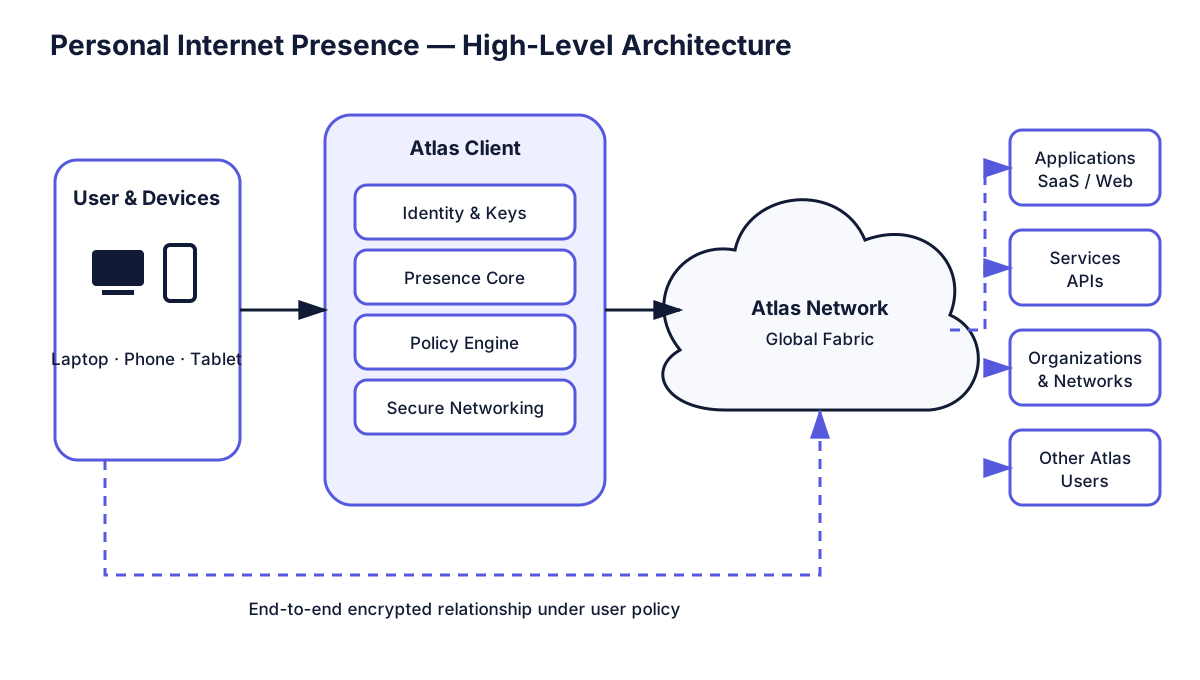
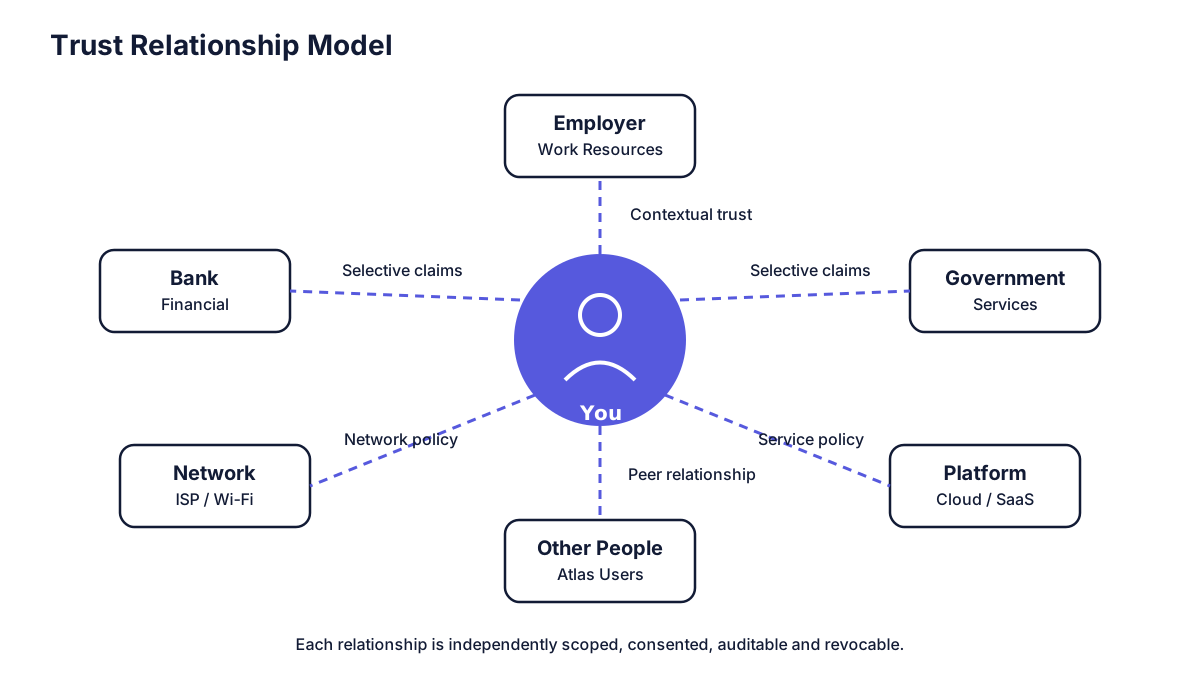
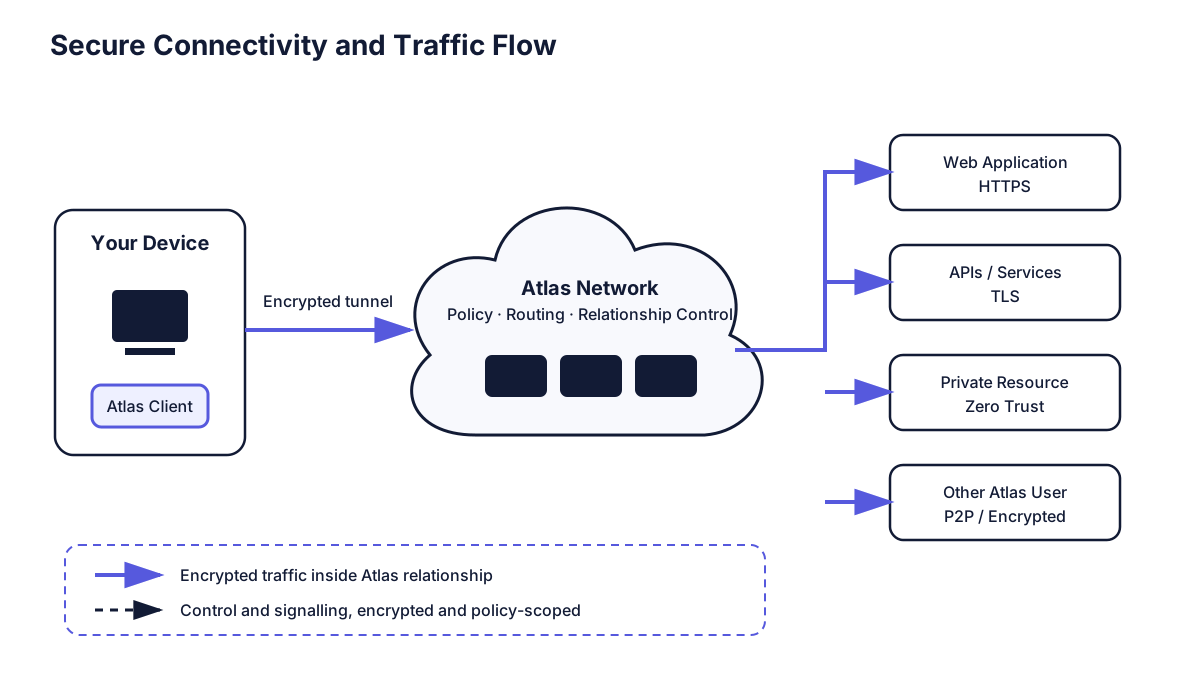
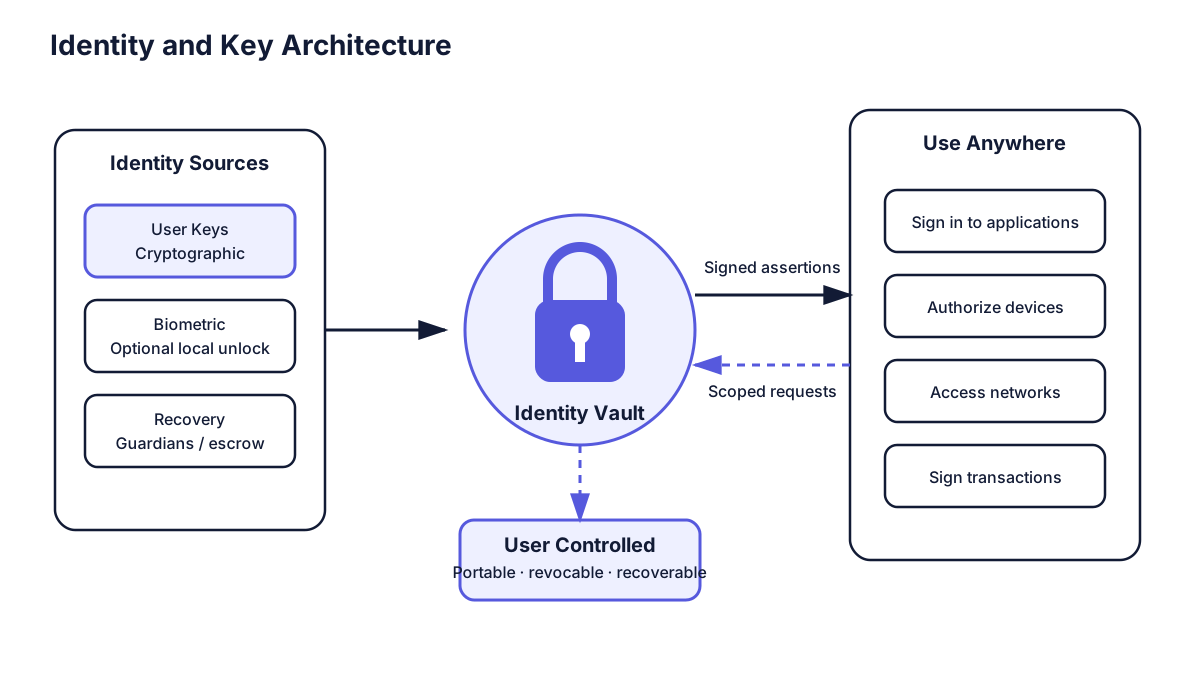
Atlas Diagram Library
Open the reusable visual reference library to view or download the current diagrams independently of this paper.
Open Diagram Library07
Comparison Framework
| Capability | VPN | Mesh | IAM | ZTNA | Atlas proposal |
|---|---|---|---|---|---|
| Encrypted transport | Core | Core | — | Often | Uses |
| Private device/service connectivity | Partial | Core | — | Partial | Uses |
| Organizational authentication | Partial | Partial | Core | Core | Uses |
| Application-access policy | Limited | Partial | Partial | Core | Uses |
| Person-controlled persistent presence | — | Limited | Limited | — | Proposed core |
| Cross-provider relationship orchestration | — | Limited | Limited | Limited | Proposed core |
| Unified privacy, trust, and routing controls | Limited | Limited | Limited | Partial | Proposed core |
This table is a research hypothesis, not a competitive claim. Reviewers are specifically asked to identify overlaps, omissions, and inaccurate boundaries.
08
Open Questions
- Does the proposed gap exist, or is it already covered by existing identity, wallet, mesh, or Zero Trust architectures?
- Would individuals value persistent Internet presence enough to adopt and maintain it?
- Which elements should be centralized, federated, or decentralized?
- How can continuity exist without creating a universal tracking identifier?
- Who issues, verifies, revokes, and disputes trust assertions?
- How should personal, professional, pseudonymous, and anonymous contexts coexist?
- What responsibilities belong to the platform, provider, organization, and individual?
- How should applications and AI agents interact with a person’s presence?
- What minimum proof of concept could falsify or validate the thesis?
- What commercial model avoids turning the individual into the product?
09
Call for Industry Review
This paper is deliberately incomplete. Its purpose is to expose the thesis to informed challenge before the architecture is overbuilt or described as solved.
Reviewers are asked to address three direct questions:
- What existing technology or architecture already does this?
- Which assumption is incorrect, incomplete, or unsafe?
- What experiment should Atlas Identity build first?
Reviews should identify specific systems, standards, papers, companies, or implementations wherever possible. Substantive corrections will be tracked in future versions.
Challenge the proposal
Submit structured technical feedback, identify prior art, or recommend an experiment.
Send a review Open a GitHub issue